
Custom plastic components for industrial OEMs
Custom Plastic Wear Pads for Industrial Equipment
Plasticpartsmfg manufactures custom plastic wear pads for machinery, lifting systems, sliding assemblies, and heavy-duty industrial equipment. Specify rectangular, round, or shaped profiles with countersinks, threaded holes, and inserts to suit your drawing and operating requirements.
From single prototypes to repeat production, we review your part files, application conditions, material options, and manufacturing route.
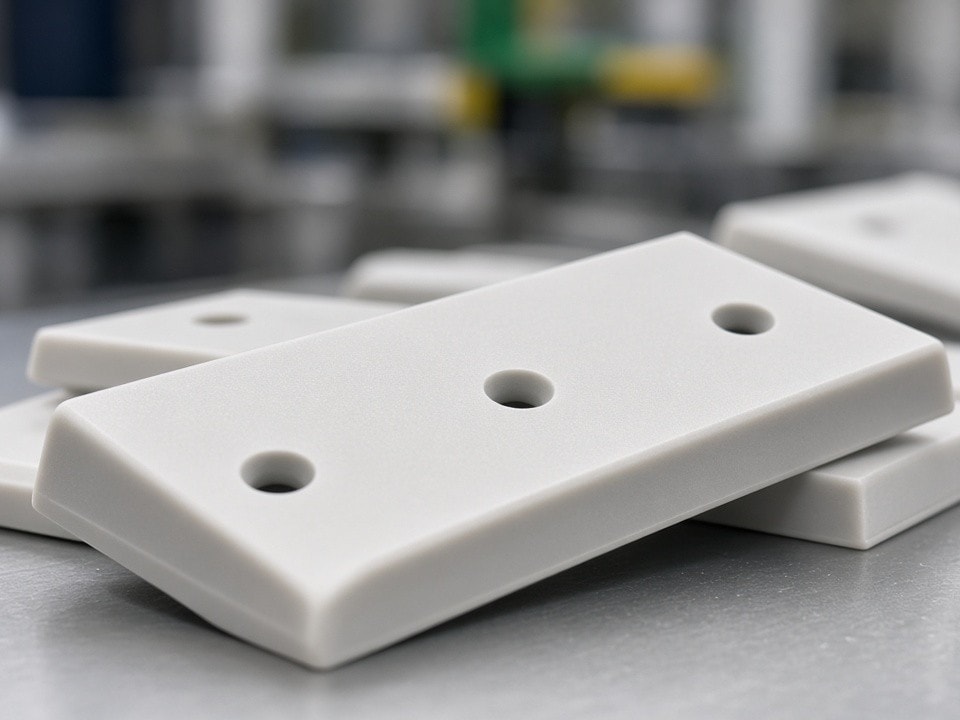
Designed around the application
Load, contact area, movement, sliding speed, mating surface, and environment all influence material and geometry decisions.
Made to your drawing
A replaceable contact surface, engineered for its job
A wear pad provides a replaceable surface between components that move, guide, support, or carry a load. Plastic may be suitable when a design calls for a non-metallic sliding or bearing surface, but performance depends on the actual load, motion, environment, and mating surface.
We manufacture from supplied CAD files, engineering drawings, or samples. Common formats include STEP, STP, IGES, X_T, STL, DXF, DWG, and PDF. If your design is still developing, share current dimensions and operating conditions for an initial process discussion.
Geometry
Rectangular, circular, or irregular profiles and contact faces.
Fixing features
Through-holes, counterbores, countersinks, threads, and inserts.
Project scope
Prototype, low-volume, or contract manufacturing review.
Common wear pad subcategories
Choose a starting point by load, motion, and mounting
Names can overlap. The working load, sliding direction, contact area, and fastening method help define the right pad geometry and intended use.
Plastic Flat Wear Pads
Flat contact faces for separating or supporting stationary and moving components across a defined contact area.
Plastic Slide Pads
Sliding interfaces for components moving along a set path or direction.
Plastic Bearing Pads
Load-bearing contact points in guided or pivoting assemblies; geometry depends on force and contact area.
Plastic Support Pads
Distribute support beneath a component or structural member.
Plastic Thrust Pads
Axial contact surfaces that resist force along a shaft or movement axis.
Plastic Machine Wear Pads
Replaceable wear surfaces for machinery and industrial equipment.
Plastic Crane Wear Pads
Custom interfaces for crane and lifting systems, subject to load and operating-condition review.
Plastic Guide Pads
Guide moving components and help maintain position along a defined travel direction.
Plastic Bolted Wear Pads
Fastened pads with specified bolt patterns, clearances, counterbores, or countersinks.
Custom Shaped Wear Pads
Irregular profiles designed around a machine contact surface or installation envelope.
These categories are starting points, not a substitute for application review. Include load direction, contact area, movement, and mounting details with your RFQ.
Application inputs that matter
Review more than nominal load
Pressure and velocity should be considered together for sliding under load. Friction, wear, and long-term dimensional stability also depend on the full operating context.
Load and contact area
Static or moving force, direction, known peaks or impacts, and the area carrying the load.
Motion and speed
Sliding, oscillating, rotating, or intermittent movement; include direction, travel, speed, and duty cycle if known.
Environment
Temperature range, moisture, chemicals, dust, and outdoor exposure can affect material suitability.
Mating surface and service
Share the contacting material, finish, and geometry, along with replacement access, wear allowance, and target maintenance interval.
Materials and manufacturing
Match the process and resin to the part
Material selection depends on friction, sliding speed, temperature, moisture, chemicals, mating-surface condition, and expected service life—not just the part name or nominal load.
POM (acetal): Often considered for machined parts requiring dimensional consistency and a smooth working surface.
PA (nylon): A candidate for some load-bearing designs; account for moisture absorption and related dimensional changes.
PE and HDPE: Options for certain sliding or impact-contact designs, depending on load, temperature, and geometry.
PEEK and PPS: Engineering plastics to evaluate when higher-performance properties are needed for the specific operating environment.
PC, PVC, PP, and other plastics: Considered when their properties and processing options fit the project.
Share a preferred resin or the conditions the pad must withstand so we can review possible material and process options.
Process options by project need
One-off part or design iteration
Consider CNC machining or 3D printing for fit and geometry evaluation. Printed parts may not represent production wear performance.
Small batch of machined pads
CNC machining can suit many custom profiles and detailed hole features, subject to material and geometry.
Repeat production quantities
Injection molding or another production process may fit when tooling, part design, and order volume support it.
Complex part requiring process review
Compare available routes against the drawing, material, quantity, geometry, and finishing requirements.
A prototype can confirm dimensions and assembly fit, but does not establish service life automatically. Wear testing should use the intended material and representative operating conditions wherever possible.
Specification and repeatability
Make critical fit requirements clear
Call out dimensions that control fit, mounting, alignment, and contact as explicit drawing requirements. Mark reference or non-critical dimensions where appropriate to focus the manufacturing review.
Parts are manufactured to agreed material, dimensional, tolerance, and surface-finish requirements. Depending on the part, secondary operations may include polishing, painting, printing, engraving, bonding, assembly, and packaging.
For repeat orders, provide the latest drawing revision and identify approved material or process requirements. Include inspection records, sample approval, or packaging expectations in the RFQ.
Industrial OEM applications
A plastic pad is not automatically suitable for every heavy-load application. Material, dimensions, mounting, and operating environment all need review.
Project questions
What helps us review your wear pad?
What should I provide if the design is not finalized?
Share current dimensions, equipment details, load direction, contact area, movement, environment, and any known constraints. We can discuss possible material and manufacturing routes.
Can a prototype prove the pad’s wear life?
Not by itself. A prototype can check dimensions and fit, but wear-life evaluation should use an appropriate material and representative operating conditions.
Which file formats can I send?
Common formats include STEP, STP, IGES, X_T, STL, DXF, DWG, and PDF. For irregular parts, a 3D model is helpful; a dimensioned drawing can clarify critical faces, fit, and orientation.
Request a quote
Send your drawings and operating details
Share CAD files, a drawing, or sample details with Plasticpartsmfg. We support prototype, low-volume, and contract manufacturing projects from Shenzhen, China.
Include these details when available
- Part quantity and expected repeat-order volume
- Material preference, load, and contact area
- Movement type, sliding speed, and duty cycle
- Temperature and environmental exposure
- Critical dimensions, tolerances, finish, and color
- Mounting details, fasteners, and inserts
- File format and drawing revision
Manufacturing location: Building 1, No. 8, Chenggong Industrial Park, Kukeng, Longhua District, Shenzhen
Email: [email protected]
Tell us about your application
Submit the project information and files through our inquiry channel.