
Custom Plastic Wear Rings Made to Your Drawings
Plasticpartsmfg manufactures custom plastic wear rings for hydraulic systems, pumps, cylinders, valves and industrial machinery. We make parts to your CAD files, engineering drawings or sample, with bore, outside diameter, thickness, split geometry and face requirements reviewed for your application.
Send us your part details and operating conditions to request a quote. We support prototypes, low-volume orders, bridge production and repeat manufacturing from Shenzhen, China.
- Prototypes
- CNC machined
- Files
- STEP / DWG / PDF
- Materials
- POM, PA, PEEK, PPS
- Volumes
- 1 pc to repeat
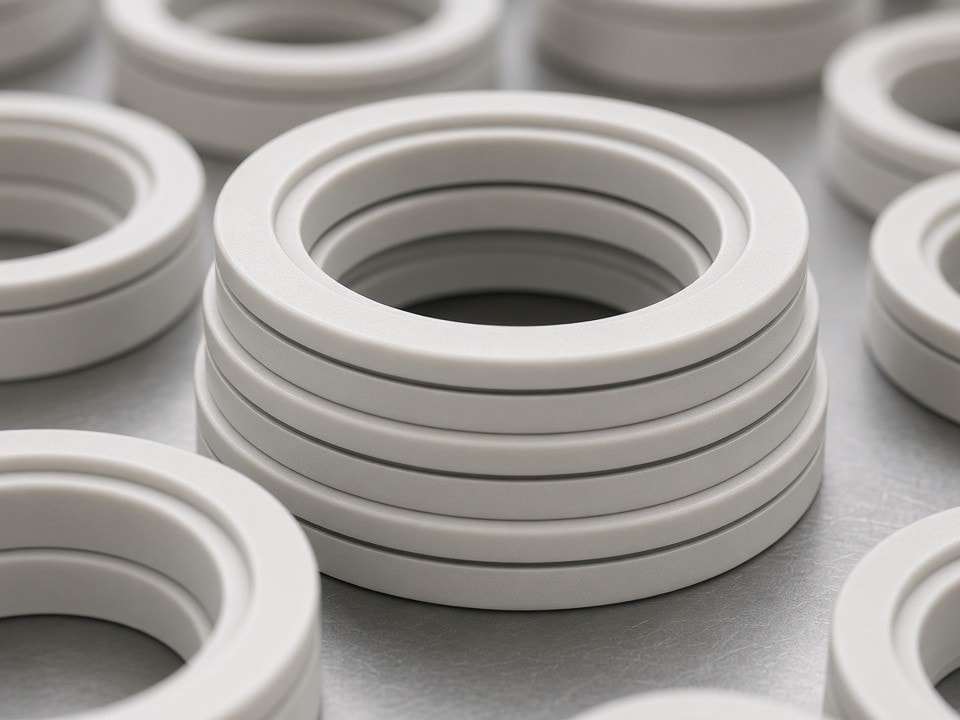
Wear Rings for Guidance and Metal Surface Protection
A plastic wear ring guides a moving component and helps manage contact between mating parts. In a cylinder, pump or valve assembly, a correctly specified ring can help reduce friction and wear, limit metal-to-metal contact, and protect mating surfaces from scoring or galling.
Wear rings are not interchangeable with general-purpose seals. Their function, material and fit depend on the assembly, load direction, movement and operating environment. We manufacture custom parts to the application and drawing requirements you provide; the final material and geometry should be evaluated against actual service conditions.
Custom Geometry, Built Around Your Assembly
We manufacture wear rings to drawing-defined dimensions and features, then review specified tolerances before quoting. Please identify critical dimensions and fits on the drawing so we can assess the proposed manufacturing route with you.
Inner and outer diameters
Matched to the piston, rod, bore or housing.
Ring thickness and axial width
Suited to the available groove and bearing area.
Split or closed construction
According to installation and assembly needs.
End-face geometry and parallelism
Defined by your drawing requirements.
Stepped profiles and grooves
Plus other custom features where the design calls for them.
Fit and clearance requirements
Coordinated with mating components.
Common Plastic Wear Ring Types
Wear ring names often describe their position or role in an assembly. The right design depends on how the part is installed, the direction of the load and the way it guides motion. These are common design categories, not a substitute for an assembly drawing — share the component location and mating-part details so we can quote the intended part rather than a generic ring.
Plastic Piston Wear Rings
Fit around a piston to guide reciprocating movement within a cylinder bore.
Plastic Rod Wear Rings
Guide a rod relative to its housing and help protect the surrounding metal surfaces.
Plastic Split Wear Rings
Use an opening to support installation or fitment around an assembly, subject to the design and operating conditions.
Plastic Guide Rings
Provide a defined guiding surface for moving components in machinery or fluid-handling equipment.
Plastic Bearing Rings
Support relative movement and manage contact between mating components.
Plastic Pump Wear Rings
Fit pump assemblies where a replaceable or custom wear interface is specified by the design.
Plastic Valve Wear Rings
Guide or support moving valve components according to the valve geometry and duty.
Plastic Compressor Wear Rings
Provide a guiding or wear interface in compressor assemblies, subject to material and operating-condition review.
Plastic Stepped Wear Rings
Include changes in profile or diameter to locate the part or match a stepped groove.
Custom Profile Wear Rings
Follow a customer-defined cross-section, groove, notch or other application-specific geometry.
Materials for Different Operating Conditions
We work with engineering and commodity plastics including POM, PA, PEEK, PPS, PC, PE, HDPE, PP and other materials selected according to project requirements. Material choice affects wear behavior, friction, strength, dimensional stability and compatibility with the working environment.
For a wear ring RFQ, tell us what the part contacts and what it encounters during operation. We can review the material request against the information provided and discuss suitable options.
Do not assume that a material used successfully in one pump, cylinder or valve will perform the same way in another assembly.
Machining for Prototypes and Low-Volume Orders
CNC machining is often a practical route for prototype wear rings, design validation and low-volume production. It allows us to manufacture custom diameters and profiles from customer drawings without committing to production tooling for a molded part.
Our broader plastic manufacturing capabilities also include injection molding and other processes. For repeat or higher-volume requirements, we can discuss whether molding is appropriate for the geometry, quantity and production plan. The recommended route depends on part design and order requirements, so we assess it as part of the quotation.
| Project need | Process to discuss | Useful for |
|---|---|---|
| Prototype or design iteration | CNC machining | Custom dimensions, profile checks and assembly evaluation |
| Small batch or bridge production | CNC machining or a suitable alternative | Initial production while demand or design is being validated |
| Repeat production | Injection molding or another appropriate process | Projects where quantity and geometry support a production process change |
We can review a future production plan alongside the immediate prototype or batch request, keeping part design, process choice and quantity discussion connected.
Engineering Details We Review
Wear ring performance depends on the assembled system, not only the ring dimensions. Include the following information where available so we can flag questions that may affect material selection, manufacturability or fit.
Pressure
Operating and peak pressure relevant to the ring's position.
Speed
Reciprocating speed, rotation or other relative movement.
Temperature
Normal and peak operating temperatures.
Media
Fluid, lubricant, gas, cleaning agent or other contact media.
Load direction
Radial, axial or changing loads on the guiding surface.
Mating parts
Materials, surface condition and component drawings.
Fit requirements
Groove dimensions, clearances and tolerances.
Installation
Split, closed or otherwise constrained assembly method.
Drawing, Finish and Part Requirements
We manufacture from CAD files, technical drawings or samples. Accepted file formats include STEP, STP, IGES, X_T, STL, DXF, DWG and PDF.
If a requirement is not yet defined, mark it as open in the RFQ. We can review the available information and identify what needs confirmation before production.
Your drawing or RFQ can specify
- ✓ Material and any required grade
- ✓ Inner diameter, outer diameter, width and profile
- ✓ Critical tolerances and fits
- ✓ End-face requirements and parallelism
- ✓ Split location or installation features
- ✓ Surface finish or texture requirements
- ✓ Quantity, delivery destination and repeat-order expectations
- ✓ Requested secondary operations, packaging or assembly
Applications We Support
Our custom plastic wear rings are manufactured for engineered assemblies used by:
We focus on drawing-based parts for business and industrial projects, not off-the-shelf retail replacement rings.
Request a Custom Wear Ring Quote
Send your CAD files or drawings together with the required quantity and application details. For an engineering-focused quotation, include pressure, speed, temperature, media, load direction and mating-part fit requirements wherever available.
We will review the part information, discuss material and process options, and clarify any open requirements for the quote.
To start your RFQ, send
- A STEP file or technical drawing
- Material preference, if specified
- Prototype or production quantity
- Operating conditions and critical tolerances
- Delivery destination and any finishing or packaging needs