
Custom PBT Parts Manufacturing Services
Plasticpartsmfg engineers and manufactures high-performance Polybutylene Terephthalate (PBT) components for automotive electrical connectors, industrial sensor housings, and precision electromechanical assemblies. Based in Shenzhen, China, we deliver rapid prototypes from 1 piece to continuous high-volume production runs using advanced CNC machining and custom injection molding.
PBT Technical Specifications Industrial Grade
- Supported Formats
- STEP, STP, IGES, X_T, PDF
- Molding Tolerance
- DIN 16742-TG4 / ±0.05 mm
- CNC Machining Tolerance
- Down to ±0.02 mm (0.0008 in)
- PBT Material Variants
- Unfilled, 15%-30% GF, FR V-0
- Dielectric Strength
- 18 - 25 kV/mm
- Production Scope
- 1 to 500,000+ Units
Dielectric Stability
PBT offers exceptional electrical insulation with high dielectric strength and arc resistance, making it the benchmark polymer for automotive switchgear and relay bases.
Thermal & Chemical Endurance
Continuous heat deflection rating exceeding 130°C (up to 200°C for GF30 variants) alongside superior resistance to motor oils, hydrocarbons, cleaning solvents, and brake fluids.
Dimensional Predictability
Low moisture absorption (<0.1% at saturation) ensures tight dimensional retention in humid conditions where traditional Polyamide (Nylon) parts suffer from dimensional expansion.
PBT Manufacturing Processes & Technical Capabilities
Select a manufacturing track below to review process specifications, tooling guidelines, material grades, and precision machining tolerances for custom PBT parts.
Custom PBT Manufacturing Solutions
At Plasticpartsmfg, we adapt our processing strategies specifically to Polybutylene Terephthalate’s semi-crystalline solidification behavior. Unreinforced PBT exhibits rapid crystallization rates and low melt viscosity, requiring precise injection velocity and barrel temperature profiles. For glass-filled PBT grades (15% to 30% GF), we deploy hardened H13 and S136 tool steels to prevent abrasive gate wear and adjust fiber orientation to manage isotropic shrinkage.
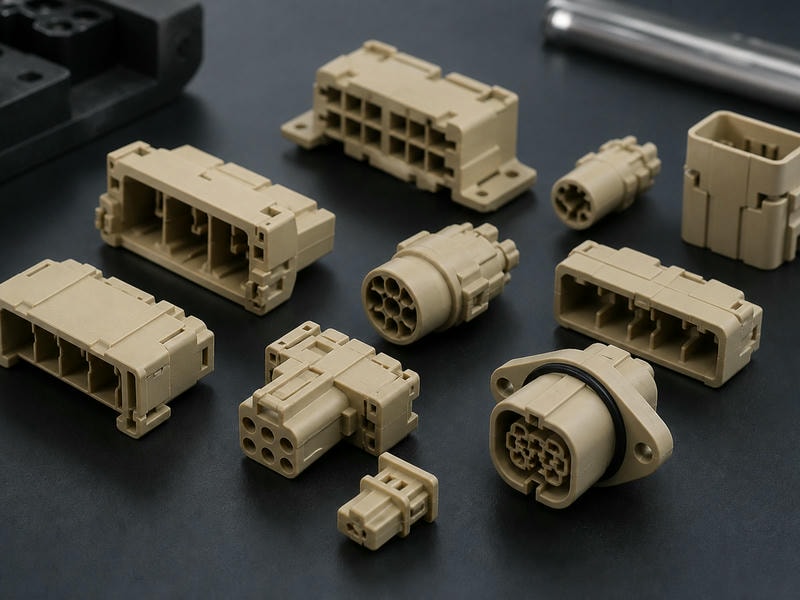
Custom PBT Injection Molding Services | PBT Part Manufacturing - Plasticpartsmfg
Plasticpartsmfg provides precision PBT injection molding services in Shenzhen, China. From prototyping to high-volume production of engineering-grade PBT components.
View details →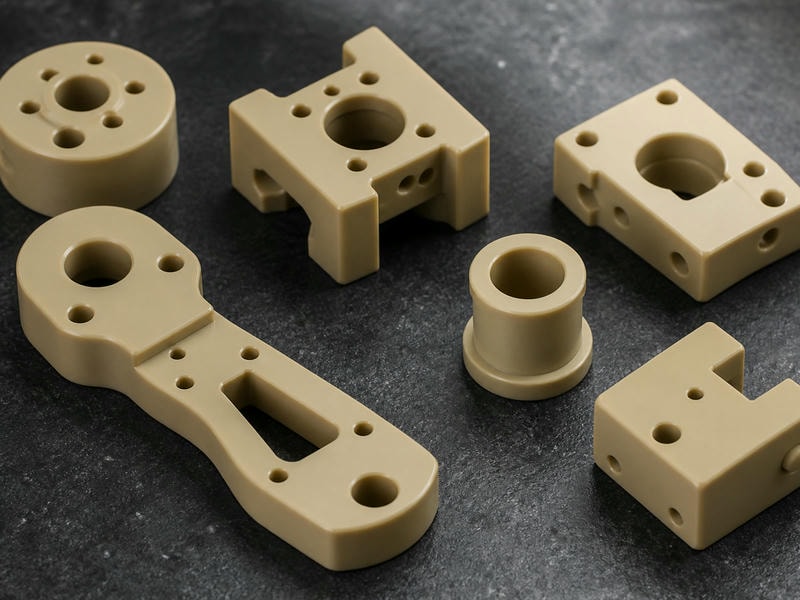
PBT CNC Machining Services | Custom PBT Components | Plasticpartsmfg
Professional PBT CNC machining services for prototypes and low-volume production. Precision milling and turning for engineering-grade PBT parts. Get a quote today.
View details →Supported PBT Material Formulations
Material test reports (MTR) and raw resin lot certificates provided with delivery
| Material Grade | Key Characteristics | Tensile Modulus | Primary Application |
|---|---|---|---|
| PBT Unfilled (Neat) | Low friction, smooth finish, superior dielectric behavior | ~2,500 MPa | Rotary switches, push buttons, terminal blocks |
| PBT-GF15 (15% Glass) | Enhanced tensile strength, moderate thermal stability | ~5,000 MPa | Sensor brackets, automotive small motor housings |
| PBT-GF30 (30% Glass) | Maximum creep resistance, HDT up to 210°C, high rigidity | ~9,500 MPa | Under-hood electrical connectors, fuse holders |
| PBT Flame Retardant (V-0) | UL94 V-0 at 0.75 mm thickness, glow wire compliance (GWFI) | ~3,000 - 8,500 MPa | Appliance circuitry, power distribution units |
PBT Design for Manufacturability (DFM) Guidelines
Wall Thickness Uniformity
Maintain nominal wall thickness between 1.2 mm and 3.5 mm. Avoid abrupt cross-sectional steps to prevent sink marks and differential cooling stresses that cause warpage in semi-crystalline PBT.
Draft Angle Requirements
Provide minimum 1.0° draft per side for untextured ribs and cores. For glass-filled PBT compounds or textured faces (VDI 3400 standard), allocate 1.5° to 3.0° to eliminate drag markings during tool ejection.
Rib Design & Radii
Design rib base thickness at 40% to 60% of adjacent main wall thickness. Apply internal corner radii of at least R0.5 mm to R0.8 mm to minimize notch sensitivity inherent in reinforced polymers.
Weld Line Management
In multi-pin connector geometry, glass-filled PBT experiences strength reduction at knit lines. Plasticpartsmfg conducts Moldflow simulation to relocate gates and guarantee structural retention at weld junctures.
Quality Control & Metrology Standards
Every production batch undergoes strict incoming resin moisture verification and dimensional verification against client drawings.
Engineering Collaboration Workflow
A structured technical process designed to transition custom PBT designs from digital CAD models into reliable production components.
CAD Review & DFM
Our engineering team analyzes your STEP/PDF drawings for mold release, wall thickness transitions, knit lines, and tight-tolerance bores within 24 hours.
Tooling / CNC Setup
Precision tool paths are generated for CNC machining, or multi-cavity hardened steel injection molds (P20/H13/S136) are fabricated in our Shenzhen facility.
T1 First Article Approval
Initial prototype samples or T1 mold shots are measured on optical comparators and CMMs. We deliver full inspection reports with physical samples before batch release.
Series Production & Pack
Consistent automated molding, secondary deflashing, ultrasonic pin insertion, custom packaging, and scheduled international air or ocean dispatch.
Request a Custom PBT Part Quotation
Submit your 3D CAD files (STEP, STP, IGES, X_T) along with 2D drawings showing critical tolerances. Plasticpartsmfg provides a thorough DFM report, tooling cost breakdown, and production schedule within 24 business hours.
Shenzhen Facility Operations
Precision toolmaking, high-speed 5-axis CNC routing, and all-electric injection presses operating in Shenzhen, China. Global logistics handled via DHL, FedEx, air cargo, and ocean freight.