
Custom plastic gear manufacturing for OEMs
Custom Plastic Gears Made to Your CAD and Drawings
Plasticpartsmfg manufactures custom plastic gears to your geometry, material, fit and quantity requirements. We review projects for robotics, automation, instrumentation, office equipment, medical equipment and precision machinery.
We make custom components—not a catalog of standard gears. Depending on design review, geometry and order quantity, production may use CNC machining or injection molding.
Have a gear drawing or CAD model? Send it with your material, quantity and critical dimensions for a manufacturing review and RFQ.
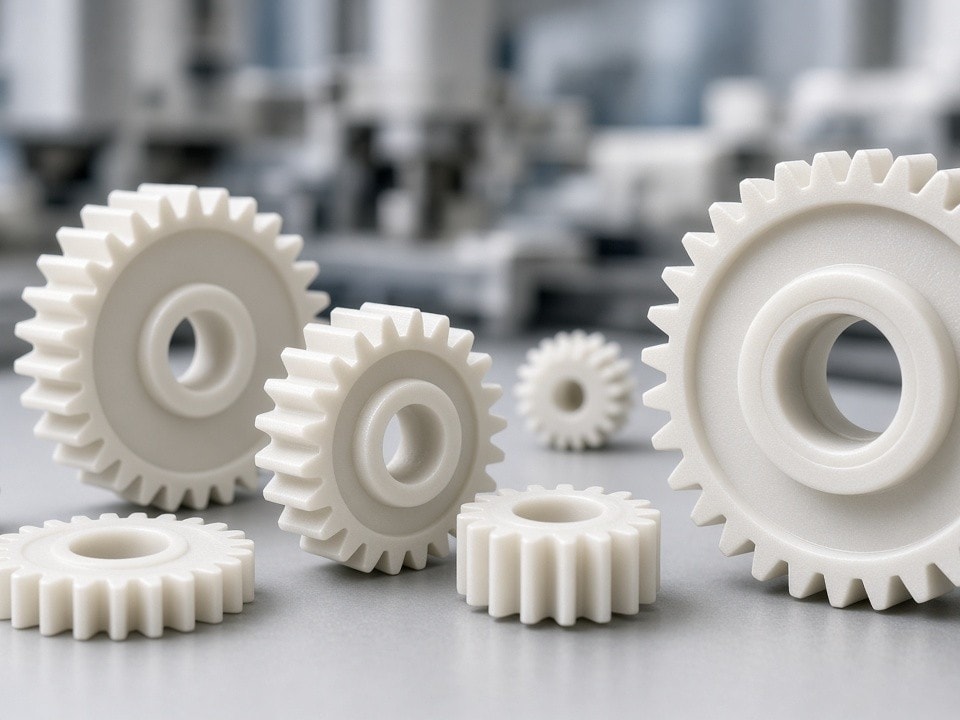
Built to your design
CAD, drawing and fit requirements
Material reviewed
POM, Nylon, PEEK and more
Route considered
CNC machining or molding
CAD-led production
Manufactured to customer geometry and drawings
Prototype to repeat orders
Production planning based on project stage and demand
Engineering review
Critical dimensions and operating context considered
Two primary routes
CNC machining and injection molding assessed
Engineering review
Plastic gear manufacturing for OEM projects
Plastic gears can reduce weight and may operate with less noise than many metal gear assemblies. Depending on material and design, they can also offer useful wear and chemical-resistance properties.
Performance depends on the gear geometry, load, speed, lubrication, operating temperature and mating components. Sharing the mating gear or assembly details helps us assess the part—outside diameter alone is not enough.
What we review for function and manufacturability
- Gear type, module or diametral pitch, and tooth count
- Pressure angle, pitch diameter and face width
- Bore, keyway, hub and mounting features
- Backlash, concentricity, runout and fit
- Material, operating conditions and expected quantity
- Mating parts, alignment and assembly clearances
Gear structures
Custom plastic gear types we can review
Use these common forms to identify the geometry in your project. These are manufacturing categories, not standard-stock products. Suitability depends on the CAD, dimensions, material and production quantity.
Plastic Spur Gears
For parallel shafts and straightforward reduction drives; tooth geometry, backlash and operating noise matter.
Plastic Helical Gears
For smoother engagement in parallel- or crossed-axis drives; the helix angle introduces axial load the assembly must accommodate.
Plastic Bevel Gears
For intersecting shafts, often at right angles; alignment, tooth contact and available space are key.
Plastic Worm Gears & Worm Wheels
For compact right-angle drives with high reduction potential; sliding contact makes material pairing, friction and heat important.
Plastic Internal Gears
For compact coaxial layouts and planetary assemblies; concentricity and clearances affect engagement.
Plastic Rack Gears
For converting rotary motion to linear travel; pitch accuracy, straightness and mounting alignment influence motion.
Plastic Pinion Gears
Small driving gears used with racks or larger gears; bore fit, tooth strength and shaft alignment need attention.
Plastic Planetary Gears
For compact, coaxial gear trains; center distance, clearances and consistency across meshing parts are important.
Plastic Sector Gears
For limited-angle or oscillating motion; define tooth coverage and end-of-travel positions.
Plastic Timing Gears
For synchronized motion; confirm the tooth profile, pitch and specified belt or mating component.
Send the drawing or model so we can assess the required gear geometry and production route.
Material selection
Materials for custom plastic gears
Material selection depends on load, speed, environment, noise targets, wear needs and production plan. Tell us how the gear will be used so material options can be reviewed against the operating conditions.
-
POM (acetal)
Often considered for dimensionally stable, low-friction moving components and general gear applications.
-
Nylon (PA)
Used where toughness and wear resistance matter; consider moisture absorption and its effect on dimensions.
-
PEEK
A high-performance option for demanding temperature or chemical environments, subject to application and cost review.
Production planning
CNC machining or injection molding?
The right process depends on geometry, material, quantity and the balance between startup cost and unit cost. We review the part and order plan before recommending a route; not every gear geometry or material suits both.
A practical route for prototypes and lower volumes
CNC machining avoids dedicated injection mold tooling and may suit initial fit, motion and assembly checks, design validation and smaller batches.
We review gear geometry and machinability, material availability, cycle time and quantity.
A route to consider for repeat production
Injection molding requires tooling, but may provide a more suitable unit cost when the design is stable and repeat or higher-volume production supports the investment.
We review mold design, draft, shrinkage, parting line, tooling cost and expected production volume.
RFQ preparation
What to include with your gear drawing
A useful RFQ lets us evaluate the tooth form, functional interfaces and manufacturing route—not just overall part size. Share as much of the following as available:
- 013D CAD in STEP, STP, IGES, X_T or STL; 2D drawing in DXF, DWG or PDF, with units and revision.
- 02Gear type, module or diametral pitch, tooth count, pressure angle and helix angle and direction where applicable.
- 03Bore diameter, keyway, hub, mounting details and mating-part or assembly information.
- 04Material grade, color, required material documentation, critical dimensions and specified tolerances.
- 05Backlash, concentricity, runout, surface finish and functional acceptance criteria.
- 06Current quantity, annual or forecast demand, repeat-order expectations, assembly and packaging needs.
Accuracy, fit and inspection planning
Tooth engagement depends on more than nominal dimensions. Tooth geometry, center distance, bore fit, concentricity, runout, backlash and alignment can all influence noise, wear and motion.
We manufacture against customer CAD files and engineering drawings. Mark the dimensions that control assembly or performance and state how the finished gear will be checked. Include any special inspection requirements and acceptance criteria with the RFQ.
We do not apply one assumed tolerance to every plastic gear. Tolerances are evaluated against the feature, material, process and part geometry. Call out critical tolerances on the drawing rather than relying on a general note.
Incomplete gear data?
Send the model, sample or available assembly information. We can identify details needed to assess the design and prepare a quotation.
From prototype to production
Plan around project stage and demand
Plasticpartsmfg supports projects from prototype through low-volume and repeat production. The best route may change as a design moves from functional testing to ongoing demand.
Prototype and engineering builds
CNC machining may suit fit, motion and assembly checks without injection mold tooling.
Low-volume or bridge production
CNC machining or another reviewed process may support builds while design or demand is being validated.
Repeat production
Injection molding may be considered when the design is stable and expected quantities support tooling.
Contract manufacturing
Discuss repeat orders, multiple part numbers, secondary operations and packaging as part of the production plan.
OEM applications
Built for engineered products and equipment
Application requirements vary. A quiet instrument drive may prioritize noise and backlash, while an industrial mechanism may place greater emphasis on wear, load and service conditions.
- Robotics and automation mechanisms
- Instrumentation and test equipment
- Office and electronic equipment
- Medical and laboratory equipment components
- Precision machinery and industrial assemblies
- Consumer and electromechanical products
Include the operating context with your drawing so we can review material and manufacturing options against the application.
Request an RFQ review
Have a custom plastic gear project?
Send CAD files, drawings or sample details to Plasticpartsmfg. Include the gear type, material preference, quantity, critical tolerances and intended application. We can review manufacturability, compare CNC machining with injection molding where appropriate, and identify missing information needed for pricing.
Accepted file formats include STEP, STP, IGES, X_T, STL, DXF, DWG and PDF. For multiple gears or part numbers, include a quantity breakdown for each.
Share your project details
Include the files and requirements that will help our team review your custom gear.