
Custom Plastic Idler Wheels Made to Your Drawings
Plasticpartsmfg manufactures custom plastic idler wheels for conveyor systems, tensioning mechanisms, cable equipment and automated machinery. We support prototype parts, low-volume orders and repeat production using processes selected for your wheel geometry, material and quantity.
Send us a STEP file, technical drawing or sample details to discuss smooth wheels, grooved profiles, bearing seats and other application-specific features.
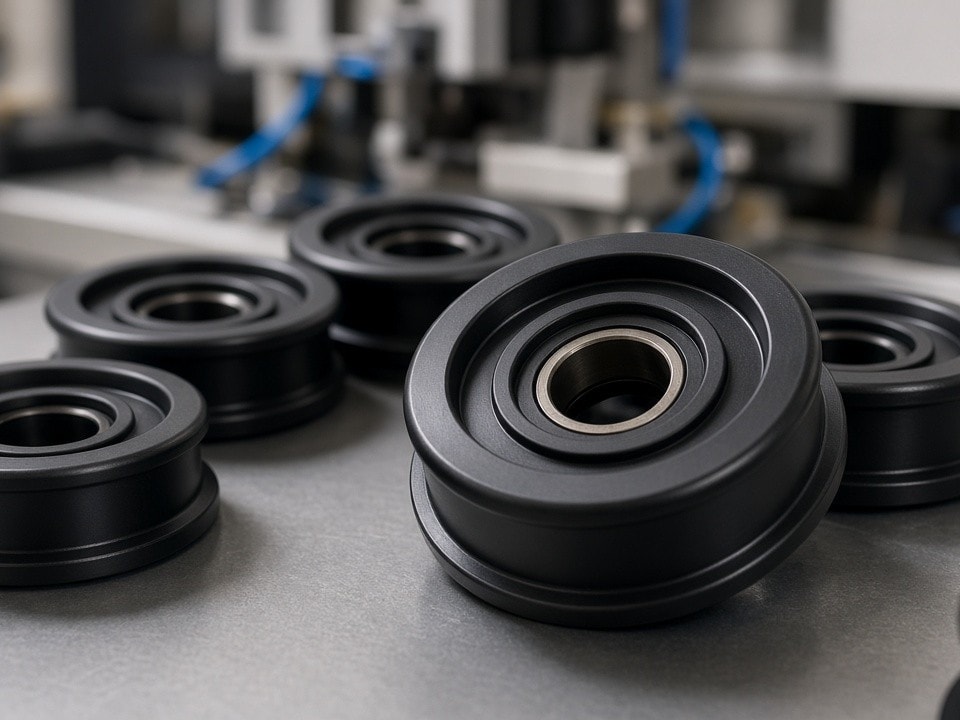
Plastic Idler Wheel Manufacturing Options
An idler wheel supports, guides or tensions a moving belt, chain or cable without serving as the primary drive wheel. Its profile, material and fit affect tracking, friction, noise and wear in the assembled machine. The right manufacturing process depends on the part design and order quantity.
CNC Machining
Prototypes, custom geometries and low-volume parts. Useful for machined bores, grooves, hubs and drawing-specific profiles.
Plastic 3D Printing
Early prototypes and fit checks. Can help assess form and assembly before selecting a production process.
Injection Molding
Repeat production and higher quantities. Requires tooling; assess the design and expected volume before committing.
Vacuum Casting
Selected short-run projects. Suitability depends on the part’s material, use conditions and required quantity.
Process selection is reviewed against your drawings and requirements. If you are comparing a prototype route with repeat production, include your expected quantities and development schedule in the RFQ.
Custom Idler Wheel Types
Plasticpartsmfg can manufacture the following custom plastic idler wheel configurations. The functional difference depends on the wheel profile and where it operates in your machine — whether its job is tensioning, guiding, supporting or reducing rotational resistance.
Plastic Belt Idler Wheels
Support or guide a moving belt along a conveyor or mechanism.
Plastic Chain Idler Wheels
Guide or support chain runs; tooth or contact geometry should match the chain and application.
Plastic Guide Idler Wheels
Help maintain a defined path for a belt, cable or other moving element.
Plastic Grooved Idler Wheels
Use a specified groove profile to locate or guide a belt, rope or cable.
Plastic Bearing Idler Wheels
Designed around a bearing seat or bearing assembly requirement.
Plastic Tensioner Wheels
Used in a tensioning mechanism to maintain contact or manage slack.
Plastic Smooth Idler Wheels
Provide a smooth running surface where a groove or flange is not required.
Plastic Flanged Idler Wheels
Use raised edges to help guide a moving element.
Plastic Cable Idler Wheels
Shaped to support and guide cable in cable-handling equipment.
Custom Idler Wheels
Made to a specified profile, bore, hub, width or other drawing requirement.
Tell us whether the wheel’s primary job is tensioning, guiding, supporting or reducing rotational resistance. That context helps us review the profile and material alongside the dimensions.
Materials for Load, Speed and Operating Conditions
Material choice depends on more than the wheel’s shape. Load, rotational speed, temperature, contact surface and exposure to oils, cleaning agents or other media can all influence performance. Common options include:
| Material | Potential reasons to consider it | Project details to review |
|---|---|---|
| POM (acetal) | Common choice for dimensionally precise machined components and moving contact parts | Load, wear requirements, temperature and bearing-seat fit |
| PA (nylon) | Considered for engineering parts subject to mechanical loading and wear | Moisture exposure, operating dimensions, load and environment |
| PE or HDPE | May suit selected low-friction or chemically exposed applications | Stiffness, loading, temperature and required profile accuracy |
| PP | Considered for applications where chemical exposure is a key factor | Mechanical loading, temperature and contact conditions |
| PEEK, PPS or PBT | Engineering-material options for more demanding application requirements | Operating temperature, media, load and project cost |
| ABS, PC or other specified plastics | May be suitable for particular functional or product requirements | Wear contact, impact, temperature and intended service |
These are starting points, not a substitute for application review. Share the operating conditions and any material preference so the selection can be assessed against the actual use case.
Geometry, Bearing Seats and Drawing Requirements
Idler wheels often combine several functional features in a compact part. We manufacture to supplied CAD files, engineering drawings or sample requirements, with details such as:
- Outside diameter, width, bore and hub dimensions
- Smooth, grooved, flanged or other specified running profiles
- Bearing-seat dimensions and the intended bearing arrangement
- Mounting features, shoulders, recesses or custom contours
- Material, color, texture and surface-finish requirements
- Assembly requirements where a bearing or other component is included in scope
Bearing Fit and Concentricity
For bearing-mounted wheels, specify the bearing identification and required fit, or provide the seat dimensions and fit requirements on the drawing. Concentricity between the bearing seat and running surface can affect vibration and tracking; identify critical datums and tolerances clearly so they can be reviewed before production.
We do not assume a standard tolerance or bearing fit for every design. Final requirements should be agreed from the part drawing and application.
Control Wear, Noise and Rotational Resistance
A wheel that fits the drawing may still need application-specific review to perform well in a machine. Wear life and running noise depend on the wheel material, surface profile, load, speed, alignment and the belt, chain or cable it contacts. Rotational resistance also depends on the bearing arrangement and assembly, not just the plastic wheel.
For a useful manufacturing review, include:
This information helps identify design and material questions before parts are made. It does not replace testing in the final machine, particularly where wear life or noise targets are critical.
Manufacturing Support from Prototype to Repeat Orders
The best route can change as a product develops. A machined or printed prototype may help check clearances and fit; a revised design may then be assessed for low-volume production or injection molding if order volumes justify tooling.
Prototype
Check profile, mounting dimensions and assembly using a small number of parts.
Engineering Validation
Evaluate material and wheel performance under representative operating conditions.
Low-Volume Production
Manufacture custom wheels without assuming that every project needs production tooling.
Repeat Production
Review injection molding or another suitable process against the part design, quantity and repeat-order plan.
Share the anticipated quantity for the first order and the likely annual or repeat requirement. This helps compare manufacturing approaches without treating a prototype and a production program as the same job.
Applications for Custom Plastic Idler Wheels
Custom plastic idler wheels may be used in:
- Conveyor and material-handling systems
- Packaging, sorting and production equipment
- Cable-handling and wire-processing machinery
- Automation equipment and robotics
- Industrial machinery and test equipment
- Custom tensioning and guiding mechanisms
For each application, the working contact, mounting method and operating environment should inform the wheel design and material. If the part is replacing an existing component, provide a sample or a complete set of dimensions and operating details.
What to Include in Your RFQ
Send the information available for your project. A complete RFQ helps clarify process, material and fit requirements:
- 1.STEP, STP, IGES, X_T, STL, DXF, DWG or PDF files
- 2.Required material, or details of the operating environment for material review
- 3.Wheel type and function: belt, chain, cable, guide, tensioner or other
- 4.Critical dimensions, tolerances, datums and surface-finish requirements
- 5.Bearing identification, seat dimensions and required fit, if applicable
- 6.Load, speed, temperature and exposure to fluids or other media
- 7.Prototype quantity, production quantity and expected repeat-order needs
- 8.Any assembly, packaging or secondary-operation requirements
Request a Quote for Custom Plastic Idler Wheels
Have a drawing, sample or defined project requirement? Send it to Plasticpartsmfg for a manufacturing review and quotation. We can discuss material options, process suitability, bearing-seat requirements and quantities based on your part information.
- Email:
- [email protected]
- Address:
- Manufacturing location:
- Shenzhen, China