
Low-Volume Thermoforming Services
Plasticpartsmfg delivers custom low-volume thermoforming for engineering, industrial, and product development projects. We manufacture rigid, thin-walled plastic components for teams requiring production-grade parts without the prolonged lead times and heavy capital expense of hardened injection tooling.
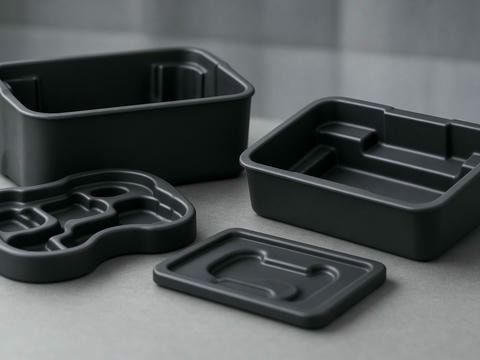
Thermoforming Capabilities & Specifications
Comprehensive manufacturing specifications tailored for functional verification, bridge runs, and end-use industrial assemblies.
| Feature | Specification |
|---|---|
| Production Quantities | 50 to 5,000+ units (Pilot runs to low-volume production) |
| Typical Materials | ABS, HIPS, PETG, PC, PVC, HDPE (Fire-rated UL94 & UV-resistant grades available) |
| Sheet Thickness Range | 0.5 mm – 10.0 mm (Material and draw-ratio dependent) |
| Tooling Types | Wood (Prototyping), High-Density Epoxy (Short run), Cast or Billet Aluminum (Extended low-volume) |
| Secondary Operations | 5-Axis CNC Trimming, Bonding, Precision Drilling, Surface Painting, Hardware Assembly |
| Accepted CAD Formats | STEP, STP, IGES, X_T, DXF, DWG, PDF (with 2D tolerances) |
| Manufacturing Facility | Shenzhen, China |
Why Choose Thermoforming for Low-Volume Production?
Thermoforming is the optimal manufacturing bridge when your project demands large, thin-walled enclosures and quick delivery without five-figure tooling investments.
Unlike injection molding, which requires high-pressure, hardened steel molds, thermoforming utilizes lower-cost single-surface tooling made from dense wood, polyurethane epoxy, or aluminum. This significantly reduces initial tooling expenditures for small-to-mid batch runs.
Thermoforming bridges the gap between slow fabrication and multi-cavity injection molds. It enables physical field testing, regulatory evaluation, and initial market deployment while your engineering team finalizes long-term design specifications.
The process delivers superior efficiency for parts with expansive surface areas, organic contours, and thin walls that would be prohibitively slow to CNC machine or too costly to produce via industrial additive manufacturing.
Because single-sided thermoforming tooling requires minimal fabrication complexity, we can progress from CAD geometry review to fully trimmed first articles substantially faster than conventional multi-plate molding systems.
Engineering Considerations for Thermoforming
Optimize your component CAD models for reliable draw depths, consistent structural rigidity, and clean demolding.
Draft Angles & Tool Ejection
Proper draft angles are vital for clean part release from the mold core or cavity. We advise a minimum draft angle of 2° to 5°, varying based on the part depth, surface texture requirement, and selected polymer. Insufficient draft causes scuff marks and part deformation during stripping.
Typical Applications
Serving hardware innovators, equipment builders, and global OEMs across high-reliability industries.
Industrial Equipment
Protective machinery covers, access hatches, splash guards, operator control panels, and durable outer equipment housings.
Medical Equipment
Specialized diagnostic instrument enclosures, clinical cart panels, mobile base covers, and chemical-resistant device casings.
Electronics & Tech
Custom server chassis covers, internal mounting brackets, robot cowlings, transit trays, and protective perimeter shells.
Automotive & Transit
Commercial vehicle interior cabin panels, modular dash components, utility vehicle wheel well liners, and battery shields.
Request a Fast Technical Quote
Plasticpartsmfg is ready to assist with your low-volume thermoforming requirements. To receive a detailed DFM review and quotation within 24 hours, share your project details and 3D CAD models.
- • 3D CAD: STEP, STP, IGES, or X_T format
- • 2D Drawings: PDF or DWG with critical tolerances
- • Specifications: Material grade, batch quantity, and trimming notes