
Automotive Plastic Parts Manufacturing Services
Plasticpartsmfg manufactures custom automotive plastic parts for engineering teams, purchasing departments, OEM suppliers, and product development companies that need precision parts made directly from CAD files, 2D drawings, or functional technical requirements.
From rapid prototypes and pre-production validation builds to low-volume production and bridge tooling, we support interior trim, structural brackets, electrical housings, under-hood components, fluid routing, and transparent optical covers.
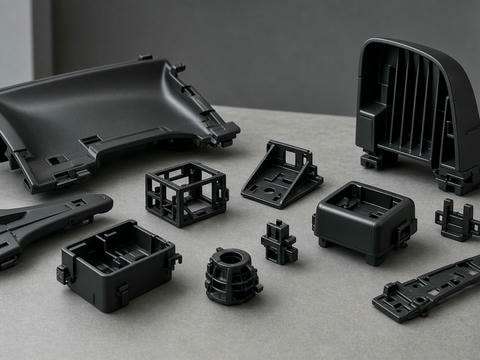
Manufacturing Capabilities for Automotive Plastic Components
The optimal process depends on order volume, material constraints, functional tolerances, surface finish, and tooling amortization. We review engineering files to recommend the most cost-effective production strategy.
| Capability | Typical Options & Specifications |
|---|---|
| Manufacturing Processes | Plastic 3D Printing, CNC Machining, Injection Molding, Vacuum Casting, Silicone Molding, Blow Molding, Thermoforming, Laser Cutting, Rotational Molding |
| Plastic Materials | ABS, PP, PE, HDPE, PVC, PC, PMMA, PET, POM, PA (Nylon), PBT, PPS, PEEK, PSU, PPSU |
| Project Stages Supported | Concept Prototypes, Engineering Validation (EVT), Low-Volume Production, Bridge Tooling, Contract Repeat Manufacturing |
| Order Quantity Range | 1 piece prototypes to 100,000+ volume production runs |
| Accepted Engineering Formats | STEP, STP, IGES, X_T, STL, DXF, DWG, PDF |
| Critical Specifications | Resin grade, masterbatch color match, critical dimensional tolerances, molded texture, flammability rating, assembly fits |
| Secondary Operations | Vapor/optical polishing, spray painting, pad printing, laser engraving, ultrasonic welding, insert bonding, sub-assembly, export packaging |
| Manufacturing Facility |
Process Options for Different Automotive Project Stages
Select a manufacturing technology below to evaluate stage suitability, typical use cases, and design considerations.
Plastic 3D Printing for Early Prototyping
Additive manufacturing is the quickest path for functional shape verification, clearance verification, ergonomic assessment, and spatial interference checks. It lets engineering teams validate spatial envelopes before committing capital to tooling or high-spec machining.
- • Ergonomic concept mockups
- • Engine bay fit-check parts
- • Sensor mounting test fixtures
- • Air duct geometry prototypes
3D printing is typically not suited for parts demanding molded anisotropic strength, long-term UV resistance, or production cosmetic textures. For structural test parts, CNC machining is recommended.
Custom Automotive Plastic Parts We Manufacture
Automotive plastic parts must satisfy rigorous environmental demands: elevated engine-bay temperatures, high impact loads, chemical exposure, electrical isolation, and rattle-free assembly.
Stage-by-Stage Support
From single-piece verification builds to full-scale program runs, our team coordinates material sourcing, tooling, secondary finishing, and quality control under one unified workflow.
Interior Trim & Panels
Console panels, trim covers, decorative bezels, glove compartment latches, and air vent louvers.
Sensor & ECU Housings
Sealed plastic enclosures for electronic controls, LiDAR brackets, and radar protection covers.
Structural Brackets & Clips
Reinforced PA/POM cable retainers, wire harness clips, spacers, and mounting fixtures.
Air & Fluid Routing
HVAC ducting, coolant reservoirs, washer tanks, oil-separator housings, and fluid lines.
Optical Lenses & Covers
Polished transparent PC and PMMA light pipes, cluster display covers, and headlamp internal lenses.
EV & Battery Components
Busbar covers, cell spacers, electrical isolation barriers, and flame-retardant enclosures.
Automotive Plastic Materials Guide
Material selection directly governs mechanical strength, heat deflection, UV durability, and solvent resistance. We manufacture using standard and high-performance automotive resins.
| Resin | Typical Automotive Uses | Key Engineering Properties |
|---|---|---|
| ABS | Interior covers, instrument housings, trim panels | High impact strength, excellent dimensional stability, good paintability and platability. |
| PP | Clips, inner liners, fluid reservoirs, splash shields | Lightweight, low moisture absorption, high fatigue resistance, economical. |
| PE / HDPE | Fuel/washer tanks, chemical containers, wear liners | Toughness, low coefficient of friction, high resistance to automotive chemicals. |
| PC | Lighting bezels, sensor covers, impact-resistant housings | Outstanding optical clarity, high heat deflection, high impact tolerance. |
| PMMA | Optical light guides, cluster lenses, exterior badge covers | Superior light transmission, UV resistance, high scratch resistance. |
| POM (Acetal) | Bushings, gear mechanisms, fuel sender brackets | Low friction, high stiffness, dimensional stability, wear resistance. |
| PA (Nylon) | Under-hood brackets, engine covers, intake manifolds | High mechanical strength, thermal tolerance (PA66-GF30), abrasion resistance. |
| PBT | Plug connectors, electronic sensor housings | High electrical insulation, thermal stability, resistance to stress cracking. |
| PPS | Coolant pumps, thermal valves, electrical insulators | Extreme chemical resistance, thermal capability up to 200°C continuous use. |
| PEEK | High-load transmission rings, specialized sensor bodies | Top-tier mechanical strength, chemical inertness, high-temperature resistance. |
Engineering Review & RFQ Verification
Accurate quotations require a comprehensive manufacturability check. When reviewing automotive plastic components, our engineers assess part geometry, tooling draft, parting lines, resin availability, and target tolerances.
CAD Files: STEP, STP, IGES, or X_T format for 3D geometry confirmation.
2D Drawings: PDF detailing critical GD&T, threaded inserts, and mating fits.
Operating Parameters: Continuous temperatures, oil/fuel contact, and load vectors.
Production Scope: Batch size, ramp-up schedules, and target delivery requirements.
Tolerances & Inspection Standard
Plastic component tolerances differ by process and resin shrinkage behavior. CNC machined plastics hold tight localized features, while molded components provide exceptional repeatability over extended runs.
- CMM and optical dimension inspection for critical features
- Material test certification (CoA) provided upon request
- Pre-production sample sign-off prior to batch production
- Export-ready packaging to prevent distortion during transit
Why International Buyers Partner With Plasticpartsmfg
We bridge the gap between engineering requirements and practical manufacturing in China, ensuring transparent communication, verified materials, and reliable delivery.
Process Flexibility
Switch from CNC prototypes to vacuum cast bridge samples and into volume injection tooling under one project manager without re-explaining specifications.
DFM & Tooling Review
Engineering evaluations identify draft angles, weld line risks, and wall thickness variations before cutting steel, preventing expensive mold rework.
Secondary Integration
From brass heat-staking inserts and laser marking to ultrasonic welding and custom protective packaging, parts arrive ready for assembly lines.
Request an RFQ for Automotive Plastic Parts
Send your CAD files, drawings, quantities, and material requirements to our engineering team. We review designs and deliver process feedback with transparent pricing.
RFQ Checklist for Fastest Turnaround:
- 3D models (.STEP or .STP preferred)
- 2D drawings with critical tolerances (.PDF)
- Preferred polymer resin (or functional requirements)
- Quantities for prototype, pilot, or serial runs
- Cosmetic finish, grain texture, or secondary operations