
Custom PP CNC Machining Services
Plasticpartsmfg delivers precision CNC milling and turning for Polypropylene (PP), serving engineering teams, product developers, and industrial OEMs worldwide. Operating from our Shenzhen facility, we machine high-performance PP components for prototypes, functional evaluation, and bridge-to-volume production.
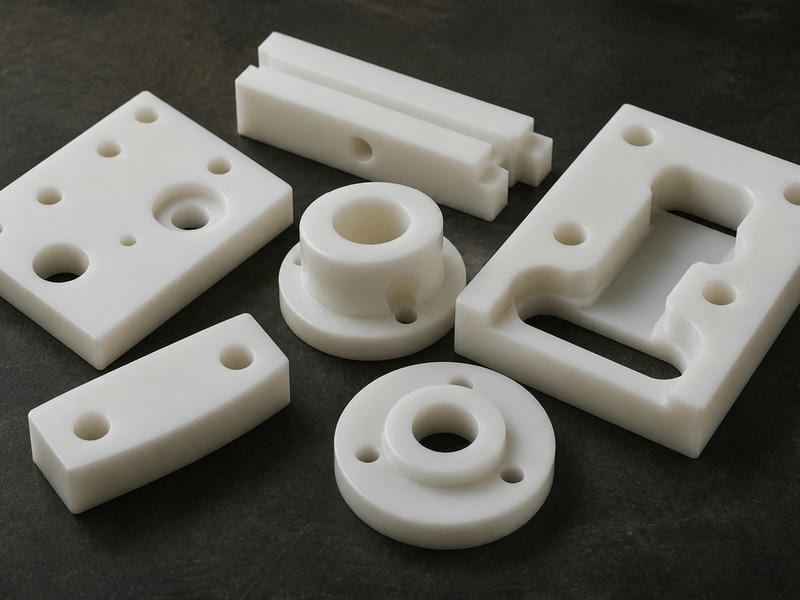
Controlled feeds, custom tool geometries, and active cooling to eliminate thermal distortion in flexible polypropylene stock.
Polypropylene CNC Machining Parameters
Polypropylene exhibits unique behaviors under friction and load. We utilize sharp rake-angle cutters, balanced fixturing, and optimized chip extraction to maintain precise geometries and clean edges without heat deformation.
| Technical Feature | Production Specification |
|---|---|
| Machining Processes | 3-Axis CNC Milling, 5-Axis Simultaneous Milling, CNC Turning & Live Tooling |
| Dimensional Tolerance | ±0.05 mm to ±0.10 mm (Part geometry and wall thickness dependent) |
| Maximum Part Size | Up to 1,000 × 600 × 500 mm |
| Production Quantities | 1 to 10,000+ pieces (Rapid prototypes to serialized bridge manufacturing) |
| Surface Finishing | As-Machined (smooth tool path), Deburring, Manual Polishing, Edge Radius Finishing |
| Accepted Formats | STEP (.stp), IGES (.igs), Parasolid (.x_t), DWG, PDF drawings |
Process Control for PP
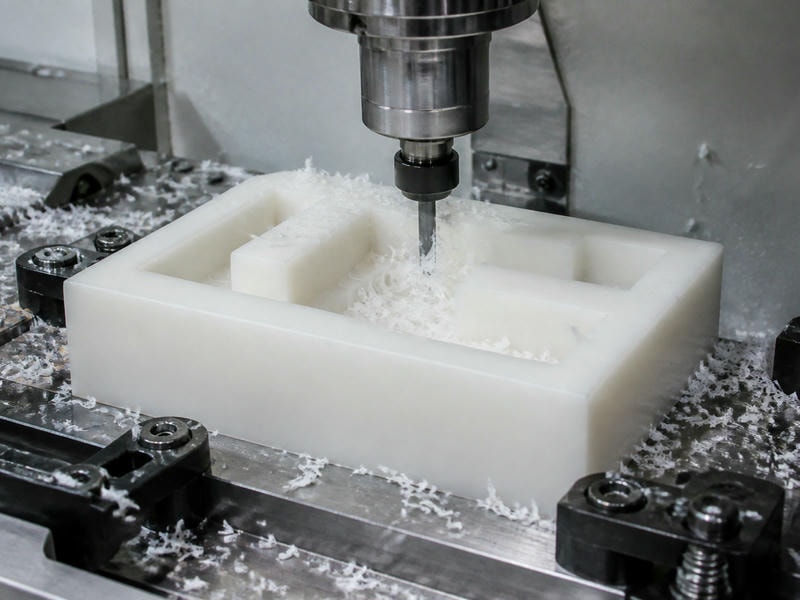
Polypropylene has a low melting point and elastic memory. Our machinists use high cutting speeds with moderate feeds and specialized single-flute or double-flute plastic cutters to avoid gumming and burr accumulation.
Why Choose PP for Your Machined Components?
Polypropylene provides a unique blend of structural toughness, minimal moisture absorption, and comprehensive chemical inertness. When machined correctly, it delivers robust functional performance in demanding operating environments.
Chemical Resistance
Exceptional resistance to dilute acids, alkalis, and aggressive solvents. Common in fluid manifolds, laboratory equipment, and reservoir housings.
Fatigue Resistance
Maintains mechanical integrity under repetitive bending stresses, making it ideal for operational hinges, dampening pads, and cyclic flexure components.
Electrical Insulation
Superior dielectric strength and high volume resistivity for non-conductive terminal housings, spacer blocks, and electronics brackets.
Food & Medical Compatibility
Safe, non-toxic polymer profile compatible with hygienic applications, food processing guides, and medical device structural components.
Production Stages & DFM Assurance
From initial CAD evaluation through serial part supply, our Shenzhen facility enforces strict Design for Manufacturability (DFM) verification to reduce production cycle time and eliminate scrap.
Rapid Prototyping
Fast turnaround validation using your native STEP or STL files. Verify form, fit, and kinematics before committing to larger production volumes.
Engineering Validation
Functional parts machined to tight tolerances for mechanical load tests, thermal evaluations, chemical exposure trials, and multi-component assembly.
Bridge Production
A cost-effective alternative to injection molding when you need hundreds of units quickly without expensive steel tooling capital commitments.
Contract Manufacturing
Scheduled recurring batches, continuous DFM optimization, and stable raw material sourcing for consistent ongoing supply chain deliveries.
Quality Assurance & DFM Engineering Review
Every incoming order undergoes technical geometry evaluation. If thin walls, unsupported pockets, or restrictive internal radii pose heat or deflection risks in PP, our engineers suggest geometry improvements before machine setup. Final inspection covers critical dimensions, thread tolerances, and surface conformity against your drawing specs.
Request a PP Machining Quote
Send your 3D CAD files and 2D engineering drawings to or use the inquiry form. Our engineering team reviews specifications promptly and returns formal pricing with lead times.
Information to Include in Your RFQ:
-
•
Quantity: Exact piece counts or batch forecasts (e.g., 5 pcs, 500 pcs).
-
•
Material Grade: Standard homopolymer PP, copolymer PP, or glass-filled PP.
-
•
Tolerances: Highlight critical fits, pin holes, and seal grooves on 2D prints.
-
•
Surface Requirements: As-machined, deburred, polished, or cleaned.
-
•
Application Context: Chemical exposure, working temperature, or mechanical stress.