
Low-Volume CNC Machining Services for Custom Plastic Parts
Plasticpartsmfg provides on-demand low-volume CNC machining for precision plastic components, engineering validation parts, bridge production runs, and small-batch manufacturing. Direct from CAD to final parts without mold tooling.
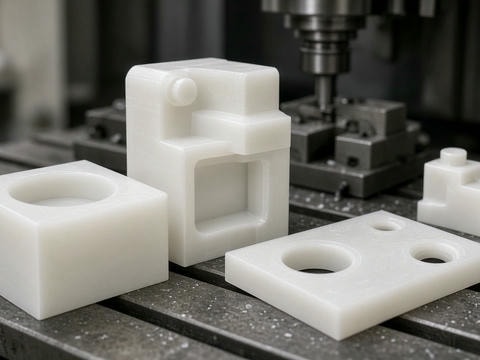
Facility & Production Location
When to Choose CNC Machining for Plastic Parts
Low-volume CNC machining utilizes subtractive milling, turning, and drilling to shape solid engineering thermoplastic blocks into functional components. It bridges the critical gap between early 3D printing and high-capital injection mold tooling.
Authentic Material Properties
Machined directly from extruded or compression-molded engineering plastic stock, guaranteeing genuine mechanical, thermal, and chemical resilience rather than printed approximations.
Eliminate Mold Investment
Save tens of thousands in upfront injection mold steel costs and weeks of tooling lead time, preserving working capital for immediate design validation.
Agile Design Modifications
Update CAD geometry between iterations with zero mold modification penalties. CAM programs adapt in hours, keeping your development timeline on track.
Precise Assemblies & Fits
Achieve bearing press-fits, tight sealing surfaces, clean tapped threads, and tight geometric tolerances that mold shrinkage or printing warping cannot deliver.
Low-Volume Production & SKUs
Ideal for specialized machines, industrial automation, medical equipment, and test fixtures where annual demand is dozens to a few thousand units across multiple variants.
Bridge-to-Production Buffer
Keep your assembly line supplied with production-ready plastic components while hard tooling is being fabricated and qualified overseas.
Low-Volume CNC Machining Capabilities
Every drawing undergoes manufacturability review to verify tool access, thermal expansion behavior, stress relaxation during cutting, and wall-thickness integrity.
| Capability Metric | Standard Operating Range |
|---|---|
| Machining Processes | CNC Milling (3, 4, 5-Axis), CNC Turning, Swiss-Type Machining, Drilling, Tapping |
| Engineering Materials | ABS, POM (Acetal/Delrin), Nylon (PA6/PA66), PC, PMMA (Acrylic), PTFE, HDPE, PEEK, PPS, PVC |
| Machining Tolerances | ±0.01 mm to ±0.10 mm (dependent on plastic thermal expansion, part geometry, and wall structure) |
| Maximum Part Envelope | Up to 1,000 × 600 × 500 mm for selected milled structures; Swiss turning up to 32 mm OD |
| Production Quantities | 1 piece to 10,000+ pieces with dedicated fixturing for batch repeatability |
| Supported CAD Formats | STEP, STP, IGES, X_T, STL, DXF, DWG, and PDF technical engineering drawings |
| Surface Treatments | As-machined, deburring, vapor polishing, optical polishing, bead blasting, texturing, painting, engraving |
| Secondary Processing | Thread inserts, ultrasonic insertion, chemical solvent bonding, mechanical sub-assembly, custom kitting |
| Facility Location |
Engineering Plastic Material Selection
Polymers behave differently under cutter loads and ambient temperatures. We stock certified raw rod, sheet, and block materials across commodity, engineering, and high-performance categories.
| Polymer | Key Properties | Typical Low-Volume Applications |
|---|---|---|
| POM (Acetal / Delrin) | High stiffness, low friction, superior dimensional stability, low moisture uptake | Gears, bushings, rollers, precision bearings, sliding guides, valve components |
| PEEK | Continuous 250°C service, harsh chemical resistance, exceptional mechanical strength | Aerospace connectors, medical implants/fixtures, semiconductor tools, downhole seals |
| Nylon (PA6 / PA66) | Outstanding wear resistance, high tensile strength, good damping qualities | Wear plates, industrial spacers, structural brackets, robotic linkages |
| PC (Polycarbonate) | High impact strength, optical clarity, heat resistance, excellent rigidity | Safety shields, sight glasses, electronic housings, protective instrument covers |
| PTFE (Teflon) | Extreme chemical inertness, near-zero friction, broad thermal range (-200°C to +260°C) | Gaskets, valve seats, high-frequency electrical insulators, cryogenic seals |
| ABS | Economical, easy to machine and bond, good impact balance, paintable | Cosmetic housings, electronic enclosures, functional test models, mounting trays |
| PMMA (Acrylic) | Exceptional optical transmission, scratch resistance, can be vapor polished to clarity | Light pipes, diagnostic manifolds, inspection windows, display screens |
| HDPE / UHMW | Zero moisture absorption, superior abrasion resistance, food-contact grade | Conveyor chain guides, wear strips, chemical tanks, fluid handling blocks |
| PPS & PVC | Dimensional stability at elevated temperatures, corrosion proof, acid resistant | Chemical etching equipment, semiconductor wet-bench blocks, pump impellers |
Machining Centers & Process Routing
Matching the geometry to the correct multi-axis machine center eliminates secondary setups, safeguards datum reference planes, and minimizes batch unit costs.
CNC Milling: Prismatic & Complex Manifold Geometry
High-speed CNC milling centers equipped with specialized plastic-cutting end mills, polished flutes, and vacuum workholding prevent heat build-up and part deformation during aggressive material removal.
Common Applications
Instrument housings, custom mounting brackets, electronic faceplates, fluidic manifolds, test sockets.
Typical Features
Deep pockets, O-ring sealing grooves, counterbored fastener holes, fine-pitch threads, 3D surface contours.
CNC Turning: Precision Cylindrical & Concentric Parts
Lathes with live tooling perform combined turning, milling, and drilling operations in a single clamp, maintaining runout and concentricity tolerances on round plastic profiles.
Common Applications
Bushings, dynamic seals, pulleys, fluid fittings, stepped shafts, threaded couplers.
Typical Features
Internal bores, external/internal threads, retaining ring grooves, cross-drilled holes, chamfers.
4-Axis & 5-Axis Machining: Compound Contours & Single-Setup Accuracy
Simultaneous multi-axis setups access five faces of a component in one holding cycle. This eliminates repositioning error, safeguards true positional tolerances, and slashes cycle times on intricate parts.
Common Applications
Aerospace ducting, impeller vanes, anatomical medical models, complex robotics end-effectors.
Typical Features
Angled cross-holes, undercut profiles, organic continuous contours, compound draft angles.
Swiss Machining: High-Precision Slender Components
Sliding-headstock Swiss machines support the plastic workpiece directly adjacent to the cutting edge, eliminating deflection when machining miniature, long, or flexible plastic pins and shafts.
Common Applications
Miniature connector pins, biomedical valves, fluid sensor probes, precision test fixtures.
Typical Features
Sub-millimeter diameters, high length-to-diameter ratios, micro-threads, burr-free slots.
Low-Volume CNC Machining vs. Injection Molding
Compare key engineering and financial trade-offs to choose the most cost-effective path for your current project phase.
| Decision Factor | Low-Volume CNC Machining | Injection Molding |
|---|---|---|
| Tooling Investment | $0 (Zero hard tooling required) | High ($3,000 to $50,000+ for steel or aluminum molds) |
| Economical Volume | 1 to 5,000+ units depending on part envelope | 5,000 to 1,000,000+ units |
| First-Article Lead Time | 3 to 7 business days | 4 to 8 weeks for mold cutting and T1 sampling |
| Design Revision Flexibility | Instant via CAM code modification | Costly and time-consuming; often requires mold recut |
| Wall Thickness Rules | Flexible: thick ribs, variable walls, and solids allowed | Strict: uniform walls required to prevent sink marks & warp |
| Unit Cost at 100 pcs | Extremely economical (no tooling amortized) | Prohibitive (amortized mold cost inflates piece price) |
Project Stages We Support
From initial single-part design verification to multi-thousand bridge production runs, our quality protocols adapt to each release phase.
Prototypes
1 – 20 Pieces
Form, fit, and functional assembly proofing using identical polymer resin grades specified for final products.
Engineering Validation
10 – 100 Pieces
Rigorous mechanical stress testing, environmental exposure, and client field trial evaluations before tooling release.
Bridge Production
50 – 5,000 Pieces
Fulfill commercial orders and ramp market inventory while hard tooling is finalized, qualified, and debugged.
Repeat Small Batches
100 – 10,000+ Pieces
Continuous production supply for specialized equipment, custom robotics, replacement spares, and multi-variant SKUs.
Precision Tolerances & Inspection Standards
Plastics possess higher coefficients of thermal expansion and lower rigidity than metals. Plasticpartsmfg manages tool heat, feeds, speeds, and clamping pressures to prevent internal stresses and dimensional creep.
- ✓ High Precision Range: ±0.01 mm to ±0.05 mm on critical bearing interfaces, precision threads, and datum pins.
- ✓ General Component Range: ±0.05 mm to ±0.10 mm on standard geometric contours, profiles, and pockets.
- ✓ Quality Metrology: CMM (Coordinate Measuring Machine), optical video comparators, thread gauges, and micrometers.
- ✓ Inspection Documentation: Full dimensional reports (FAIR) and material certificate verification supplied upon request.
Surface Finishing & Value-Add Options
Deliver end-use plastic components ready for final assembly with comprehensive in-house post-processing operations.
Deburring & Edge Breaking
Manual knife and tumbling deburring removes fine tool flash and leaves smooth parting lines.
Vapor & Optical Polishing
Chemical vapor smoothing on PC and acrylic restores crystal transparency on light guides and lenses.
Bead Blasting
Even satin matte surface finishes remove all micro-tool path swirls for clean cosmetic shells.
Inserts & Assembly
Thermal brass threaded insert installation, solvent bonding, pad printing, and sub-assembly.
Industries Relying on Low-Volume Plastic CNC
We serve mechanical engineers and procurement teams across critical technology sectors requiring exacting plastic performance.
Robotics & Automation
Lightweight arms, sensor housings, custom end-of-arm grippers.
Medical & Lab Devices
Diagnostic manifolds, surgical tool handles, PEEK fixtures.
Aerospace & Defense
Flame-retardant fairings, avionics insulators, lightweight brackets.
Electronics & Sensors
Dielectric standoffs, RF-transparent radomes, enclosures.
Industrial Equipment
Low-friction wear pads, POM gears, fluid control bodies.
Automotive & EV
Battery module insulators, fluid connectors, prototype ducting.
Optical Systems
Precision acrylic windows, light diffusers, sensor lenses.
Subsea & Chemical
PTFE and UHMW fluid components, acid-resistant manifolds.
Request a Machining Quote
Upload your CAD geometry and 2D engineering drawings. Our engineering team reviews all part features for manufacturability, tolerance safety, and resin availability within 24 hours.
RFQ Checklist for Faster Quotes:
- • 3D CAD: STEP, STP, IGES, or X_T models
- • 2D Drawings: PDF or DWG with critical tolerances and thread callouts
- • Resin Specification: Generic polymer or specific commercial resin grade
- • Quantity Matrix: Prototype batch size and expected production volumes
- • Post-Processing: Polishing, bead blast, threaded inserts, marking